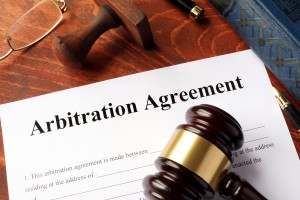
 An arbitration agreement or clause is a part of a contract in which parties agree that certain types of disputes may be handled through arbitration instead of litigation. If you sign a binding arbitration agreement, you relinquish your rights to pursue a remedy in court. But what if you are unhappy with the arbitration clause as it stands? Can you negotiate a change?
The answer is, it depends. You may be able to negotiate some parts of the mandatory arbitration clause in your insurance contract, but you could also be denied coverage for refusing to agree to the clause.
The basics of an arbitration proceeding
An arbitration proceeding is a dispute resolution process conducted privately in which either a single arbitrator or a panel of arbitrators serves in the capacity of a judge. Commonly, the arbitrator is a judge or lawyer with experience in a specific area of law and provides the arbitration services for a fee. The rules of arbitration are not as stringent as those in a standard court proceeding. There is also no jury involved. After each side has presented its case along with evidence, the arbitrator issues a decision, which is usually final, with little to no opportunity for appeal.
Although it may seem more reasonable to go through arbitration rather than through a court proceeding, the consensus is that arbitration gives companies a distinct advantage over the people who sign their contracts. The following reasons support this view:
- No jury
- Limited discovery process
- Confidentiality (no public record)
- No appeals possible (except for blatant arbiter misconduct)
Negotiating an arbitration clause in an insurance policy
Unfortunately, you may have limited options if your insurer requires you to sign an arbitration agreement. Courts have consistently given insurers the green light to make the signing of an arbitration clause a prerequisite of obtaining policy, much as they have with nursing homes, employees, and other companies. Stated another way, you may be denied coverage if you do not agree to sign an arbitration clause.
However, there may be times when you can “get around” an arbitration agreement. You can negotiate the contract from the start, before you agree to sign anything, to include provisions for:
- Who chooses the arbiters
- How discovery is presented
- Who will pay which fees
- Whether certain types of claims can still be brought in court
If you are unable to negotiate, you should seek the advice of an experienced Tennessee insurance dispute attorney. In some cases, your arbitration clause may actually be invalid. If you must abide by it, then you deserve to have a lawyer who is experienced in representing policyholders in these types of disputes.
Read More:
- What You Don’t Know about Arbitration Clauses Could Hurt You in an Insurance Dispute
- Mandatory Arbitration? Time to Check Your Policy
- Arbitration Agreements and the “Effective Vindication of Rights” Argument
- WATCH: Is a Lawsuit My Only Option?
If you need help with the negotiation of an arbitration clause, our Tennessee insurance dispute attorneys are here to provide you with the legal counsel and advice you need. The Gilbert Firm serves clients from offices in Nashville, Chattanooga, Jackson, Memphis, and Knoxville. To set up a free case review with one of our attorneys – Clint Scott, or Jonathan Bobbitt, or Brandon McWherter – give us a call at 888.996.9731, or use our contact form.
 You have obtained liability insurance as a responsible property owner. In addition, you have paid your insurance premiums on time. Holding up your end of the bargain, you certainly have a right to expect your insurance company to be there for you if you become the object of a liability claim or suit. However, what does it mean if your insurer sends you a reservation of rights letter detailing various reasons why they may not cover you for certain events related to your policy?
 Gilbert McWherter Scott Bobbitt PLC is proud to announce that the firm has been selected for inclusion in the 2020 list of “Best Law Firms,” presented by U.S. News – Best Lawyers®. The Firm has also been awarded a Tier 1 ranking in the Memphis area for its work in:
 The average person doesn’t always read his or her insurance policy, except in one or two instances – when it becomes necessary to file a claim or when an insurance claim is denied by the insurer. We understand why: these contracts are often filled with dense legal jargon, and reading them can seem like an exercise in futility for most people. Knowing the actual definitions of your insurance policy is essential when the time comes to access the benefits you have or you assume you have under your policy.
 A major misconception held by many employers and employees is that any employee who receives a salary is not eligible to receive overtime pay. Although earning a salary is one of the criteria listed for each of the exemptions, it is only one of many. If all of the requirements under an exemption are not satisfied, you are not exempt, and are owed overtime pay.
 Having bricks installed on the exterior of your Tennessee home helps improve the overall appearance and value of the home. The problem with bricks, though, is that insurance companies often try to avoid paying for matching materials when repairs are required. Today, we’d like to look at why that is.
 It’s been in the news for weeks now, but in case you missed it,
  Tennessee has a lot of condominiums. When condo owners suffer losses, they sometimes face challenges that single-family homeowners don’t. The insurance company may deny the claim based on exclusions, or lowball the claim based on the type of damage done.
 Residential and commercial builders are now using drones to perform aerial views of properties, enabling them to use the recorded images and data for more efficient and accurate construction activities. Drone videography and photography services are also used by real estate agents and property developers to market listings and prospect for land development opportunities, respectively.
 A class-action lawsuit filed recently in Philadelphia state court claims that Travelers is selling rot insurance to homeowners while concealing the actual terms of the proposed coverage. According to the lawsuit, Travelers Home and Marine Insurance Co. allegedly markets and sells add-on homeowners’ insurance to consumers that is supposed to provide coverage for rot and fungus damage. However, the insurance policy fails to explain that certain causes of rot damage are not included in the coverage.