 Beginning in 2013, Mr. Gilbert’s law firm, Gilbert McWherter Scott Bobbitt PLC, embarked upon what would become a civil rights project of integrating children with intellectual disabilities into regular public school classrooms. Too often, they found, these children were educated in separate classrooms, with only other children with disabilities.
Mr. Gilbert examined the research, including international studies where children with intellectual disabilities were offered a choice: an opportunity to be educated with their non-disabled peers or, if the families wanted, in classrooms designed solely for children with disabilities. The results of these longitudinal studies showed greater advances for the children who were integrated with nondisabled peers. They had higher skill sets, better speech, improved behavior because of their non-disabled peer models, and were more than a grade-level ahead.
Taking this research into the United States through Tennessee, Mr. Gilbert realized that the educational funding system from the state incentivized the creation of separate classes. Put simply, the funding system financially rewards school systems for the creation of separate classrooms rather than integrated ones. Thus, Mr. Gilbert’s law firm set out to change the funding system while working on cases of segregation of children with Down syndrome.
LH v. Hamilton County
 The first case, LH v. Hamilton County, involved a second grade student with Down syndrome who was ably performing in the regular education classroom. However, in third grade, state standardized testing scores came into effect, and the school attempted to remove LH to an entirely separate school, in a different zone, for only children with disabilities.
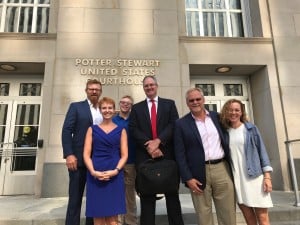
Mr. Gilbert hired some of the best experts, both internationally and in the United States. This included the founder of Down Syndrome Education International, Dr. Sue Buckley of the United Kingdom. A five-year legal fight for LH led to multiple reported decisions, culminating in a decision by the Sixth Circuit Court of Appeals in favor of LH. L.H. v. Hamilton Cty. Dep_t of Educ._ 900 F.3d 779
Thus, LH established the rules for integration, including how students with intellectual disabilities are entitled to modified work, differentiated instruction, an aide as needed, and they do not have to meet the same grade level standard as students without intellectual disabilities.
LH became the law governing Tennessee, Ohio, Michigan, and Kentucky. It resulted in damages and tuition reimbursement to the family of over $200,000, plus legal fees and expenses of $350,000.
JA v. Smith County
After LH, Mr. Gilbert continued his work with very young children with intellectual disabilities. In a federal case in Nashville District Court, he established that it is discriminatory for a school system to put its resources into a special education classroom intended mostly for students with disabilities, to the detriment of the regular education classroom. J.A. v. Smith Cty. Sch. Dist._ 2018 U.S. Dist. LEXIS 21
In JA, Mr. Gilbert successfully argued the school system propagated a myth that children with intellectual disabilities should be taught separately. He explained how children with disabilities are entitled to supports in regular education such as speech and language supports, along with behavioral supports, before a school system can consider removing a child from the regular education classroom. To receive an “appropriate” education, the supports must be delivered first.
A.A. v. Walled Lake
 Recently, Mr. Gilbert took the non-segregation fight to Michigan where he was asked to assist the Michigan Protection and Advocacy (MPAS) in a case just outside of Detroit. A.A. v. Walled Lake Consol. Schs_ 2017 U.S. Dist. LEXIS
After four trips to Detroit, a three-year litigation culminated with a federal trial in 2019. On the first day of trial, the parties were able to settle with a three-year plan that involves mandatory district training on inclusive practices, plus payment of a private school from kindergarten through eighth grade, along with $250,000 in fees and costs.
As a result of these cases, Mr. Gilbert has begun working with the National Down Syndrome Society (NDSS) and other organizations to formulate a guidance for parents, teachers, and school systems concerning the proper legal analysis for integration of children with intellectual disabilities.
 It is the hope that these cases, and the guidance, will ensure that children with intellectual disabilities can be taught with their nondisabled peers to the maximum extent appropriate, the vision of the Individuals with Disabilities Education Act (IDEA).
Related Content
Integration of Children with Developmental Disabilities in Social Activities
Integration of Children with Disabilities into School Community
Benefits of Integration of Students With Disabilities
The Impact of Inclusion on Students With and Without Disabilities and Their Educators
Teacher Perceptions of Mainstreaming/Inclusion, 1958–1995: A Research Synthesis
The Perspectives of Students With and Without Disabilities on Inclusive Schools
If your child has been isolated or removed from a classroom because he or she has an intellectual disability, you have options to explore. Please contact Justin Gilbert at 888.966.9731, or fill out this contact form, and reserve a consultation time at one of our office locations. The Gilbert Firm maintains offices in Nashville, Chattanooga, Memphis, Jackson and Knoxville, and advocates for clients across Tennessee and the Southeast.
 The Gilbert Firm always fights to protect children whose rights have been violated. We recently assisted with a case involving Tennessee children with epilepsy, which resulted in a groundbreaking new decision in Knoxville. In SP v. Knox County, the court found that a school may not segregate and bus children with epilepsy, who have a prescription for Diastat, to a non-zoned school as a matter of convenience. Doing so violates the Individuals with Disabilities Education Act (IDEA), Section 504 of the Rehabilitation Act of 1973, Title II of the Americans with Disabilities Act of 1990 (ADA), and Tennessee state law. Additionally, the court found that the state of Tennessee’s own department of education may be held liable for not correcting Knox County’s discrimination.
 All students in the U.S. are entitled to a free public education. It does not matter what race, religion, ethnicity, sex, or background a child has; his or her right to public education is protected under various state and federal laws. When a child has been denied her right to this education because of systemic and illegal racial discrimination, the family has recourse through the laws to uphold their child’s rights.
 Like public schools, public colleges have an obligation to provide courses and content that is accessible to those students with disabilities, such as vision or auditory impairment. When the
  You join a branch of the military. You do a tour (or two, or even more) in a dangerous area. You come home with the expectation that you will build a life for yourself, and that includes getting a job outside of the service. And yet day after day, you find yourself turned down for positions that you know you could hold, and that you know fit your skillset. Or you do get a job, and find yourself subjected to harassment by your coworkers and/or your superiors. What can you do?
 There’s something charming about Airbnb, a “home sharing” company that allows travelers to
  Jerton Evans has been coaching football a long time. He spent his college years playing for the University of Virginia, but when his professional career stalled, he obtained a degree and began picking up coaching jobs in different areas. In 2015, he took a position at Claiborne High School, where he taught English and coached the Bulldogs football team.
 There was a really interesting article in
  The Supreme Court is called upon to handle some of the most complex cases of our time. As it turns out, we need them to handle cases where common sense should have taken care of the problem in the first place.